



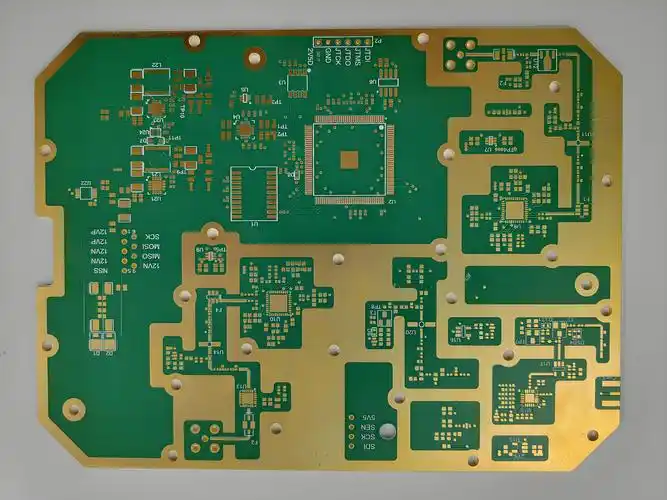
RO4003 PCB
Composition and Structure: RO4003C is a common version of RO4003. It is a hydrocarbon composite material reinforced by glass cloth and filled with ceramic, not a PTFE material. Currently, RO4003C uses 1080 and 1674 glass - fiber fabrics and exhibits good electrical and mechanical properties.Dielectric Constant: At a frequency of 10GHz, its dielectric constant Dk is 3.38 ± 0.05. The recommended value for circuit design is 3.55. The dielectric constant has minimal volatility with temperature and is quite stable over a wide frequency range. This enables it to maintain good signal - transmission performance in high - frequency applications.
Loss Factor: The loss factor Df at 10GHz is 0.0027. It features low dielectric loss. In high - frequency applications, it has a distinct advantage over ordinary circuit materials, effectively reducing energy loss during signal transmission.
Get a Quote
I. Material Positioning and Core Composition
In high - frequency electronic fields such as 5G communication, aerospace, and radar detection, the electrical properties and processing adaptability of materials directly determine the system's reliability. The RO4003 series of laminates introduced by Rogers Corporation, as a core member of the RO4000 family, achieves a perfect balance of low loss, high stability, and easy processing, thanks to its composite structure of ceramic - filled hydrocarbons. It has become a benchmark material for high - frequency circuit design.
1.1 Material Positioning
RO4003 is a thermosetting high - frequency laminate specifically designed for microwave and millimeter - wave circuits. It belongs to the category of ceramic - filled hydrocarbon composite materials, not the traditional PTFE (polytetrafluoroethylene) material.
1.2 Core Composition
Its core structure uses 1080 and 1674 glass - fiber fabrics as reinforcing substrates. By filling and modifying the hydrocarbon resin matrix with ceramic particles, a three - dimensional composite system of "resin - ceramic - glass fiber" is formed. This structure not only retains the low dielectric loss characteristics of hydrocarbons but also compensates for the insufficient mechanical strength and poor dimensional stability of pure organic materials through ceramic filling and glass - fiber reinforcement, providing a stable physical carrier for high - frequency signal transmission. Currently, the mainstream model in the market is RO4003C. Its performance indicators fully comply with the IPC - 4103 standard specifications. It is available in various thicknesses ranging from 0.101mm to 1.524mm, copper - foil thicknesses from 0.5oz to 2oz, and standard sizes including 24"×36" (610×915mm), 36"×48" (1220×915mm), etc. It also supports customized cutting to meet the needs of different devices.
II. Key Performance Parameters and Technical Advantages
The core competitiveness of RO4003 stems from its excellent performance in high - frequency environments. Its key parameters have been precisely optimized:
2.1 Electrical Performance: The Core Guarantee for High - Frequency Transmission
- Dielectric Constant (Dk): At a frequency of 10GHz and 23℃, the standard value of the dielectric constant of RO4003C is 3.38 ± 0.05, and the recommended value for circuit design is 3.55. More importantly, its Dk value fluctuates minimally in the wide temperature range from - 55℃ to 150℃, with a temperature coefficient of only + 40ppm/℃, and remains highly stable in the frequency band from 5GHz to 40GHz. This stability can effectively avoid the phase - shift phenomenon in signal transmission, ensuring the matching accuracy and filtering characteristics of RF circuits.
- Loss Factor (Df): The loss factor at 10GHz is as low as 0.0027, only 1/7 of that of traditional FR4 materials (about 0.02), far superior to ordinary high - frequency materials. The low Df characteristic significantly reduces the energy attenuation in signal transmission, making RO4003 perform outstandingly in long - distance high - frequency communication.
- Insulation and Electrical Resistance Performance: The volume resistivity reaches 1.7×10¹⁰MΩ・cm, the surface resistivity is 4.2×10⁹MΩ, and the dielectric strength can reach 312kV/mm at a thickness of 0.312mm, meeting the insulation requirements of high - power high - frequency circuits.
2.2 Thermal and Mechanical Performance: The Basic Support for Structural Stability
- Thermal Stability: The glass transition temperature (Tg) is greater than 280℃, and the thermal decomposition temperature (Td) reaches 425℃, fully compatible with lead - free soldering processes (such as 260℃ reflow soldering). The coefficient of thermal expansion (CTE) in the Z - axis is 46ppm/℃, and the CTE in the X/Y - axis in the range from - 55℃ to 288℃ is 11ppm/℃ and 14ppm/℃ respectively, highly matching the thermal expansion characteristics of copper foil (about 17ppm/℃), which can significantly reduce problems such as solder - joint cracking or inter - layer separation caused by thermal shock.
- Mechanical Strength: The tensile strength reaches 139MPa, the flexural strength is 276MPa, and the tensile modulus is 16.7GPa. Coupled with the glass - fiber - reinforced structure, it solves the pain point of weak mechanical properties of pure PTFE materials. It has excellent dimensional stability, with an X/Y - axis change rate of less than 0.3mil/inch, ensuring the processing accuracy of precision circuits.
- Environmental Resistance: The water absorption rate is only 0.04%, much lower than that of FR4 materials (about 0.15%), effectively avoiding performance degradation in humid environments. The thermal conductivity is 0.71W/m・K, 2.8 times that of ordinary FR4 (about 0.25W/m・K), suitable for the heat - dissipation needs of high - power components.
III. Processing Technology Characteristics: The Core Source of Cost Advantage
One of the biggest advantages of RO4003 is its process compatibility with ordinary FR4 laminates, completely solving the pain points of high - processing difficulty and high cost of high - frequency materials:
3.1 No Special Pretreatment Required
Unlike PTFE materials that need special processes such as sodium etching to process through - holes, RO4003 can be directly produced using conventional PCB processing equipment, such as automated grinding machines and CNC drilling machines.
3.2 Standardized Processing Flow
- Cutting: Conventional cutting equipment can be used during cutting, and only material identification needs to be done well to avoid material mixing.
- Drilling: It is recommended to use a new drill bit, with a thin aluminum sheet and a high - density backing plate to reduce burrs. No special treatment is required after drilling (some water - absorbent high - frequency materials need high - temperature baking).
- Surface Treatment: The soaking process of high - frequency hole - conditioning agent can be omitted, and direct copper - plating can be carried out, greatly simplifying the process.
3.3 High - Precision Processing Adaptability
It supports the production of fine circuits. With a professional impedance - control process, an impedance tolerance of ±5% can be achieved, meeting the precise requirements of microwave circuits.
IV. Typical Application Fields and Scenario Values
The performance combination of RO4003 makes it the preferred material in many high - end fields:
4.1 5G Communication Field
It is widely used in core components of 5G base stations, such as RF power amplifiers, antenna elements, and filters. Its low - loss characteristic can extend the signal coverage distance, high stability ensures the transmission quality of multi - band signals, and process compatibility reduces the manufacturing cost of base - station PCBs.
4.2 Aerospace and Defense
It is suitable for microwave circuits in radar systems (1GHz - 77GHz) and satellite communication equipment. In extreme temperature and humidity environments, its low water absorption and high thermal stability can ensure the long - term reliable operation of equipment, and its radiation - resistant characteristics can also meet the special needs of spacecraft.
4.3 Industry and Instrumentation
It is used in the signal - processing units of high - frequency sensors and precision measurement equipment. The low Df characteristic improves the signal detection accuracy, and the dimensional stability ensures the measurement consistency of the equipment during long - term use. Compared with similar materials, RO4003 has formed a clear application positioning: its performance is better than FR4, covering the frequency - band requirements from 5GHz to 30GHz; its processing difficulty is lower than that of pure PTFE materials, and the cost is only 60% - 70% of that of PTFE laminates, making it a cost - effective choice in the medium - to - high - frequency field.
V. Comparative Advantages and Market Value
Compared with common high - frequency materials, the competitive advantages of RO4003 are concentrated in the balance of "performance - cost - process":
5.1 Comparison with FR4
The dielectric loss is reduced by more than 85%, the stability of the dielectric constant is increased by 3 times, and the thermal stability is significantly enhanced, meeting the medium - to - high - frequency application scenarios that FR4 cannot cover.
5.2 Comparison with PTFE Materials
The processing cost is reduced by 30% - 40%, no special equipment and processes are required, the yield rate is increased to over 90% (usually less than 80% for PTFE materials), and the mechanical strength and dimensional stability are better.
5.3 Comparison with RO4350B in the Same Series
The loss factor is lower (0.0027 vs 0.0037), making it more suitable for scenarios sensitive to signal attenuation; RO4350B has more advantages in thermal conductivity and flame retardancy (94V - 0), suitable for scenarios such as power circuits.


