


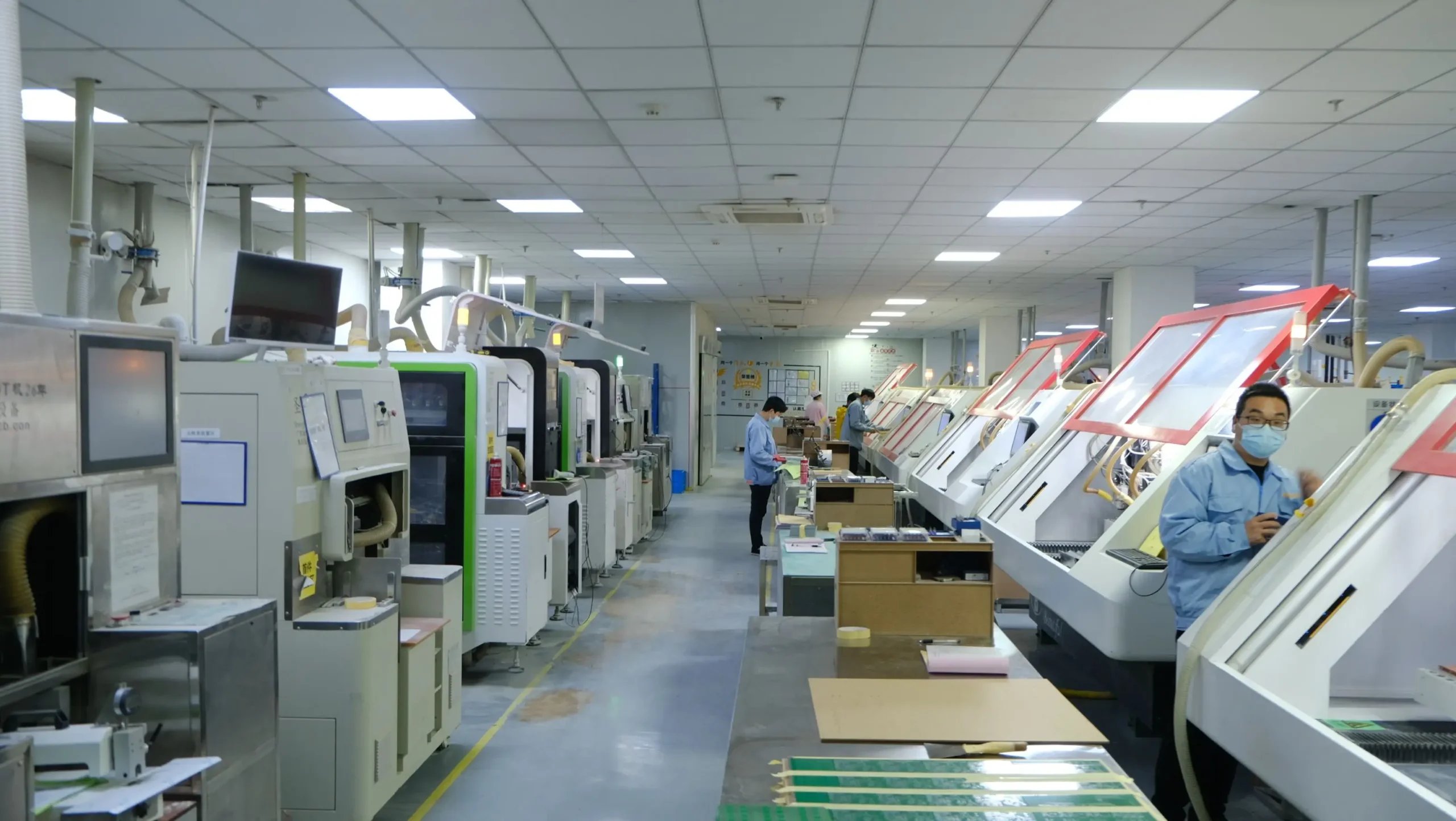
PCB CNC machine
PCB CNC (Computer Numerical Control) machines are automated devices that precisely control mechanical movements through computer programs to achieve processing such as drilling, milling, and shaping of printed circuit boards (PCBs). Their core logic is to convert PCB design files into commands recognizable by the machine, driving the actuator to complete high - precision processing.
Get a Quote
- 数据输入和预处理:从设计文件到加工指令
在处理之前,需要将印刷电路板(PCB)的设计数据转换成数控系统(CNC)可以解释的“语言”。这是实现自动化加工的基础。
导入设计文件:首先,获取PCB设计源文件。常见的格式包括:
- Gerber文件:在PCB行业中广泛使用的图形描述文件,包含钻孔位置、铣削路径和电路布局等关键信息(例如,钻孔层文件.DRL,外形铣削层文件.GKO)。
- CAD文件:例如来自AutoCAD的.dwg文件或来自专业PCB设计软件(Altium Designer, PADS)的本地文件,从中可以直接提取加工路径。
数据解析与优化:CNC控制系统(例如基于G代码的系统)解析这些文件。核心处理包括: - 坐标转换:将设计文件中的“相对坐标”(例如,以印刷电路板的左下角为原点)转换为机床的“绝对坐标”(以机床工作台的原点为参考)。
- 路径规划:优化加工顺序(例如,“先钻小孔,后钻大孔”,“先加工内层,后铣削外边缘”)以避免工具碰撞或PCB变形。
- Parameter Matching: Automatically match the tool type, spindle speed, and feed rate according to the processing requirements (e.g., when drilling a 0.1mm small hole, the spindle speed needs to reach over 150000rpm, and the feed rate is controlled at 5 - 10mm/min to avoid tool breakage).
Generate CNC Instructions: Finally, convert the processed data into G - code (a common instruction for CNC machining, e.g., G01 represents linear interpolation motion, G81 represents the drilling cycle) and M - code (auxiliary function instructions, e.g., M03 starts the spindle to rotate forward, M08 turns on the coolant), and store them as executable program files for the machine.
- Workbench Positioning: Fixing the PCB and Calibrating the Datum
The PCB needs to be precisely fixed on the workbench and aligned with the machine's coordinate system to ensure no deviation in the processing position.
PCB Fixing Methods: Different fixing schemes are adopted according to the PCB type (rigid / flexible, thin / thick):
- Vacuum Adsorption: The mainstream method. The workbench surface is distributed with dense small holes. A negative pressure is generated by a vacuum pump to firmly adsorb the PCB (the adsorption force can be adjusted according to the PCB thickness, e.g., the adsorption force for a thin FPC is about 0.05MPa, and for a thick power board is about 0.1MPa), avoiding damage to the PCB by mechanical fixtures.
- Mechanical Clamping: For large - size or thick - copper PCBs (e.g., ≥3mm thick), it is fixed from all around through edge clamps to prevent the PCB from moving during processing.
Datum Calibration (Alignment): Confirm the actual position of the PCB through a vision system or a mechanical probe to compensate for the placement deviation: - CCD Vision Alignment: A high - resolution CCD camera is installed on the workbench. It takes pictures of the “datum points” (usually 2 - 4 circular marks) on the PCB, compares them with the coordinates of the datum points in the design file, calculates the X/Y - axis offset and rotation angle, and automatically adjusts the workbench position. The alignment accuracy can reach ±0.003mm.
- Mechanical Probe Alignment: A metal probe contacts the edge of the PCB or a preset positioning hole to confirm the physical datum, which is suitable for the processing of simple PCBs without datum points.
- Actuator Movement: Completing Machining Actions According to Instructions
This is the “action - taking part” of the machine, which is completed by the cooperation of the spindle system (tool drive) and the servo - drive system (workbench / spindle movement). The core is “high - precision, high - stability” motion control.
(1) Spindle System: The “Power Source” of the Tool
The spindle is the core component that installs the tool (drill bit, milling cutter) and drives it to rotate, directly determining the processing accuracy and efficiency:
- Function: According to the instructions, it realizes “start / stop”, “forward / reverse rotation”, and “speed change”. Different processing requirements correspond to different spindle performances:
- Drilling Spindle: With an extremely high rotation speed (usually 80000 - 200000rpm), it ensures that the cutting edge is sharp when drilling small holes (e.g., 0.05mm), reducing burrs on the hole wall.
- Milling Spindle: With a greater torque (usually a power of 1.5 - 5.5kW), it can cope with the “cutting resistance” during PCB outline milling, avoiding rough edges caused by milling cutter jams.
- Structure: Air - bearing spindles or ceramic - bearing spindles are mostly used. The former has no mechanical contact and extremely low vibration (vibration amplitude ≤ 0.5μm), which is suitable for ultra - precision processing; the latter has strong wear resistance and is suitable for large - batch continuous production.
(2) Servo - drive System: The “Precision Controller” of Movement
It consists of servo motors (X/Y/Z - axis motors), ball screws / linear guides, and encoders, and is responsible for driving the workbench (X/Y - axis) or the spindle (Z - axis, controlling the tool's up - and - down movement) to move according to the instructions: - Motion Control Logic: Adopting “closed - loop control” to ensure accuracy. The encoder continuously detects the actual speed and position of the motor, compares them with the target values in the instructions. If there is a deviation (e.g., the workbench should move 10mm but actually moves 9.998mm), the servo system will immediately adjust the motor output to compensate for the deviation. The final positioning accuracy can reach ±0.001 - 0.005mm.
- Axis Movement Division of Labor:
- X/Y - axis: Drive the workbench (or the spindle) to move on the horizontal plane to achieve “aligning the tool to the processing position” (e.g., moving to the specified hole position during drilling, moving along the path during milling).
- Z - axis: Drive the spindle to move up and down to control “the tool's cutting depth” (e.g., when drilling, the Z - axis descends to the PCB thickness + 0.1mm to avoid drilling through the workbench; when milling, controlling the milling depth to ensure the outline size).
- Processing Process Monitoring: Ensuring Quality and Safety in Real - time
During processing, sensors and vision systems are needed to monitor in real - time to avoid an increase in the scrap rate caused by abnormalities (such as tool breakage, PCB offset).
Tool Condition Monitoring:
- Tool Breakage Detection: There are two ways to judge whether the tool is broken:
- Current Detection: The current of the spindle motor changes with the cutting resistance (e.g., when the tool breaks, the cutting resistance disappears and the current drops suddenly). When the system detects an abnormal current, it immediately stops the machine.
- Optical Detection: During the processing interval, a laser sensor scans the length of the tool. If the length suddenly becomes shorter (e.g., the tool becomes 2mm shorter after breaking), an alarm is triggered.
Processing Depth Monitoring: A “linear grating scale” is installed on the Z - axis to continuously feedback the actual cutting depth of the tool. If it exceeds the preset value (e.g., it should drill 0.8mm deep but actually drills 1mm), the Z - axis movement is immediately stopped to avoid drilling through the bottom - layer circuits of the PCB.
PCB State Monitoring: The CCD camera can take pictures of the PCB surface during the processing interval to detect problems such as “missing drilling”, “hole position offset”, and “over - cutting of the milling edge”. If defects are found, they are automatically marked and the processing is paused for manual confirmation.
- Auxiliary Systems: Ensuring Processing Continuity and Stability
In addition to the core processing links, the auxiliary systems are the “support” for the long - term stable operation of the machine, mainly including:
- Automatic Tool Changer (ATC): For multi - process processing (e.g., “drilling holes of different diameters + milling the outline”), the tool magazine (usually can hold 20 - 200 tools) will automatically change tools through a robotic arm according to the program instructions. The tool - changing time is ≤2 seconds, without the need for manual intervention.
- Cooling System: During processing, the friction between the tool and the PCB generates high temperatures (e.g., the local temperature during drilling can reach over 200℃). The cooling system sprays “insulating coolant” (to avoid short - circuits) or compressed air to reduce the tool temperature and remove chips (such as copper chips generated during drilling), prolonging the tool life and ensuring processing accuracy.
- Chip Removal System: Copper chips and PCB debris generated during processing are collected into the waste bin through a negative - pressure suction nozzle or a scraper to prevent debris accumulation from affecting processing (e.g., debris getting stuck between the tool and the PCB causing hole - position deviation).
总结:核心逻辑是“精确控制”
PCB CNC机器的本质是“用计算机指令取代手动操作”。通过“数据解析→基准定位→精确移动→实时监控”的闭 loop过程,它实现了PCB的高精度和自动化加工。其精度(±0.001 - 0.005mm)和效率(单台机器每天可以加工数百个PCB)远超手动操作,使其成为现代PCB制造(从消费电子产品到半导体封装)中不可或缺的核心设备。
PCB CNC机器的本质是“用计算机指令取代手动操作”。通过“数据解析→基准定位→精确移动→实时监控”的闭 loop过程,它实现了PCB的高精度和自动化加工。其精度(±0.001 - 0.005mm)和效率(单台机器每天可以加工数百个PCB)远超手动操作,使其成为现代PCB制造(从消费电子产品到半导体封装)中不可或缺的核心设备。


