



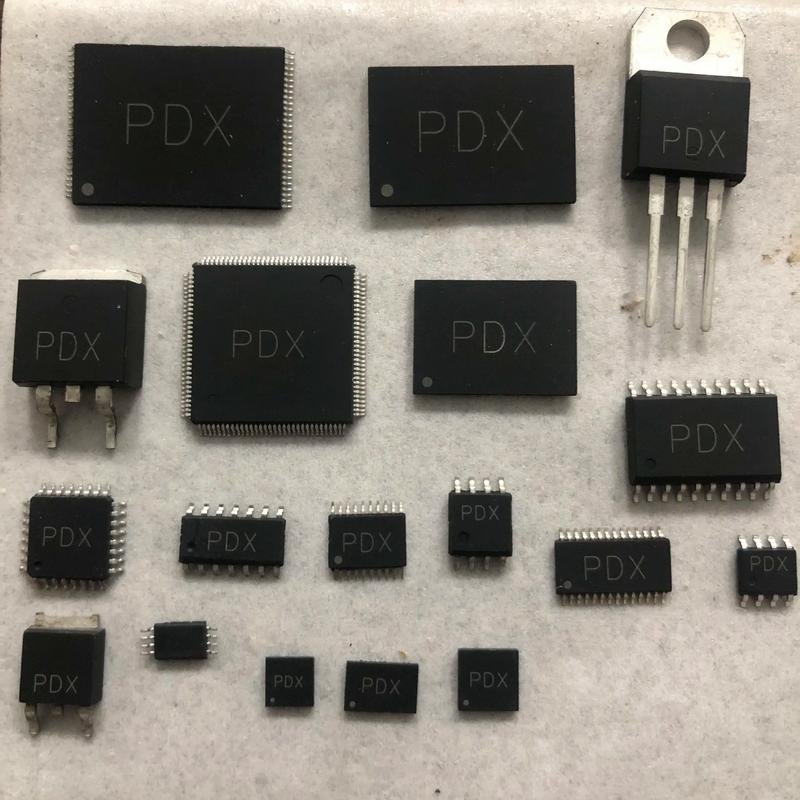
PCB Component
电子元件是电子电路的基本构建模块。它们的核心功能包括信号处理、能量转换和逻辑运算,利用导电、能量存储、放大和控制等多种电气特性。无论是简单的手电筒还是复杂的宇宙飞船,所有电子设备的功能都依赖于元件的适当选择和组合。
根据其功能和特性,电子元件可以分为三类主要类别。无源元件不需要外部电源即可运行,包括电阻器、电容器和电感器。有源元件则需要外部电源,例如二极管、晶体管和集成电路。机电元件具有机械和电气功能,例如连接器和开关。每类元件都有其独特的原理、应用和选择标准。
Get a Quote
I. Passive Components: The "Fundamental Support" of Circuits
Passive components do not have the ability to amplify signals or control logic on their own. They are mainly used to stabilize circuit parameters, suppress interference, and transmit energy, making them the most widely used and distributed type of components in electronic circuits. The core types include resistors, capacitors, and inductors.
1. Resistors: The "Current Limiter" for Controlling Current
The core function of a resistor is to impede current flow through its resistance value, enabling voltage division, current limiting, load matching, and other functions. It is one of the most basic components in circuits. Its working principle is based on Ohm’s Law (R=U/I), where the resistance value is determined by the manufacturing material (e.g., carbon film, metal film), length, and cross-sectional area. During operation, resistors convert part of the electrical energy into heat, so attention must be paid to the rated power limit to prevent overheating and burnout.
Key Parameters:
- Resistance Value: Measured in ohms (Ω), with common units including kiloohms (kΩ) and megaohms (MΩ). Accuracy is divided into general grades (±5%, ±10%) and precision grades (±1%, ±0.1%).
- Rated Power: The maximum power the resistor can withstand (measured in watts, W), with common values of 0.125W, 0.25W, and 0.5W. Insufficient power will cause the resistor to overheat and burn out.
- Temperature Coefficient: The rate at which resistance changes with temperature (ppm/℃). Precision circuits (e.g., instrumentation) require metal film resistors with a low temperature coefficient.
Common Types and Applications:
- Carbon Film Resistors: Low cost and moderate accuracy, used in general civilian circuits such as flashlights and toys.
- Chip Resistors (e.g., 0402, 0603 packages): Small size and suitable for automated surface mount technology (SMT), widely used in high-density PCBs like those in mobile phones and computers.
- Potentiometers (variable resistors): Allow manual adjustment of resistance, used in scenarios such as audio volume controls and desk lamp dimmers.
2. Capacitors: The "Energy Storage Vessel" for Charges
A capacitor consists of two insulated electrodes and a dielectric (e.g., ceramic, electrolytic paper) between them. Its core function is to store charges, filter signals, block direct current (DC), and couple alternating current (AC), acting like a "temporary battery" in circuits. Its working principle is as follows: when a voltage is applied across the electrodes, the dielectric polarizes and stores charges (Q=CU, where C is the capacitance value); when the voltage changes, the capacitor charges and discharges, enabling it to "pass AC and block DC".
Key Parameters:
- Capacitance Value: Measured in farads (F), with common units including microfarads (μF), nanofarads (nF), and picofarads (pF). Accuracy is mostly ±10% or ±20%.
- Rated Voltage: The maximum working voltage the capacitor can withstand (e.g., 6.3V, 16V, 50V). Exceeding this voltage will cause dielectric breakdown and damage the capacitor.
- Polarity: Divided into polarized (e.g., aluminum electrolytic capacitors, tantalum capacitors) and non-polarized (e.g., ceramic capacitors) types. Polarized capacitors must be installed with the "positive terminal connected to high potential"—reversing the polarity will cause burnout.
Common Types and Applications:
- Ceramic Capacitors (MLCC): Small size and excellent high-frequency performance, used for decoupling and filtering next to chip power pins (e.g., 100nF capacitors).
- Aluminum Electrolytic Capacitors: Large capacitance (μF level) and low cost, used for power filtering in power adapters and washing machine circuit boards.
- Tantalum Capacitors: High stability and small size, used in miniaturized devices such as mobile phones and laptops.
3. Inductors: The "Electromagnetic Converter" for Storing Magnetic Energy
An inductor is made by winding a wire around a magnetic core (e.g., ferrite, silicon steel sheet) or an air core. Its core function is to store magnetic energy through electromagnetic induction, enabling filtering, current choking, resonance, and other functions. It is often used to process high-frequency signals or stabilize current. Its working principle is: when current passes through the coil, a magnetic field is generated and energy is stored; when the current changes, the changing magnetic field produces an induced electromotive force (Lenz’s Law) that opposes current changes, allowing the inductor to "pass DC and block AC".
Key Parameters:
- Inductance Value: Measured in henries (H), with common units including millihenries (mH), microhenries (μH), and nanohenries (nH).
- Rated Current: The maximum working current the inductor can withstand. Exceeding this current will cause magnetic core saturation, a drop in inductance, or even coil burnout.
- Q Factor: An indicator of inductor loss—the higher the Q factor, the lower the loss. High-frequency circuits (e.g., WiFi modules) require inductors with a high Q factor.
Common Types and Applications:
- Chip Inductors: Small size and suitable for SMT, used for high-frequency filtering in mobile phones and routers.
- Power Inductors: High current-carrying capacity, used in DC-DC power converters.
- Transformers (special inductors): Achieve voltage step-up or step-down through mutual inductance (e.g., step-down transformers in power adapters).
II. Active Components: The "Functional Core" of Circuits
Active components require an external power supply to operate and have active functions such as signal amplification, logic judgment, and energy conversion. They serve as the "brain" of electronic devices, enabling complex functions. The core types include diodes, transistors, and integrated circuits (ICs).
1. Diodes: The "Electronic Valve" for Unidirectional Conduction
Diodes are made of semiconductor materials (e.g., silicon, germanium) and have the core characteristic of "unidirectional conduction"—they only allow current to flow from the anode (positive terminal) to the cathode (negative terminal) and block reverse current. They are often used in rectification, voltage regulation, detection, and protection circuits.
Common Types and Applications:
- Rectifier Diodes (e.g., 1N4007): Convert AC to DC, used in the rectifier circuits of power adapters.
- Zener Diodes (e.g., 1N4733): Maintain a stable voltage when reverse-biased and breakdown occurs, used for circuit voltage regulation (e.g., 5V reference voltage).
- Light-Emitting Diodes (LEDs): Emit light when forward-biased, used in mobile phone notification lights and LED displays.
- Schottky Diodes: Low forward voltage drop and fast switching speed, used for high-frequency rectification in mobile phone charging circuits.
2. Transistors: The "Core Device" for Signal Amplification and Switching
A transistor consists of three semiconductor regions: the emitter (E), base (B), and collector (C). Its core function is to use a small current at the base to control a large current between the collector and emitter, enabling signal amplification or electronic switching. It is the foundation of both analog and digital circuits.
Operating Modes:
- Amplification Mode: A small signal input at the base results in an amplified in-phase signal output at the collector (e.g., audio power amplifiers that amplify weak audio signals into high-power signals).
- Switching Mode: When the base current is sufficient, the transistor saturates and conducts (equivalent to a "closed switch"); when there is no base current, it cuts off (equivalent to an "open switch"). This mode is used for logic control, such as MCU I/O ports driving LEDs or relays.
Common Types and Applications:
- NPN Transistors (e.g., S8050): Commonly used as switching or amplification transistors to drive small loads.
- PNP Transistors (e.g., S8550): Used in combination with NPN transistors to form complementary symmetric circuits.
- Power Transistors (TO-220 package): High current-carrying capacity, used in motor drives and power circuits.
3. Integrated Circuits (ICs): Highly Integrated "Functional Modules"
Integrated circuits integrate components such as diodes, transistors, resistors, and capacitors onto a single semiconductor chip using semiconductor processes. They realize complex system functions (e.g., computation, storage, control) and are key to the miniaturization and high performance of electronic devices. Their core characteristics include high integration (from thousands to tens of billions of components), low power consumption, and high reliability.
Common Types and Applications:
- Microcontrollers (MCUs) (e.g., STM32, Arduino): Integrate a CPU, RAM, ROM, and I/O interfaces, used for controlling smart home sensors and toy robots.
- Central Processing Units (CPUs) (e.g., Intel i7, Apple A18): High-performance computing cores, used for logic operations in computers and mobile phones.
- Power Management ICs (PMICs): Realize voltage conversion and charging management, such as the charging chips in mobile phones.
- Memory Chips (e.g., DDR RAM, Flash chips): Used for data storage, such as the storage space in mobile phones and the memory in computers.
III. Electromechanical Components: The "Physical Interface" for Connection and Interaction
Electromechanical components combine mechanical structures with electrical functions. They are mainly used for physical connection, signal switching, and environmental sensing in circuits, serving as the "bridge" between electronic devices and the external environment. The core types include connectors, switches, and sensors.
1. Connectors: The "Physical Link" of Circuits
Connectors are used to transmit current or signals between different circuit modules or devices. Their core requirements are reliable contact, easy plugging, and anti-interference.
Common Types and Applications:
- Chip Connectors (e.g., 0.8mm pitch FPC connectors): Used for connecting mobile phone screens to motherboards.
- USB Type-C and HDMI Interfaces: Used for connecting devices to external equipment (e.g., mobile phone charging, computers connecting to external monitors).
- Terminal Connectors: Used for wire harness connections in industrial equipment (e.g., motor control wires, sensor signal wires).
2. Switches: The "On-Off Controller" of Circuits
Switches control circuit on-off or signal switching through mechanical actions (e.g., pressing, toggling) and are important components for human-machine interaction.
Common Types and Applications:
- Tactile Switches: Such as mobile phone power buttons and keyboard keys—they conduct when pressed and cut off when released.
- Toggle Switches: Such as the power switches or mode selection switches in toys.
- Relays: Switches that use a small current to control a large current, used for car light control and motor control in industrial equipment.
3. Sensors: The "Electronic Senses" for Environmental Sensing
Sensors convert physical quantities (temperature, humidity, light, pressure) into electrical signals to provide environmental data for circuits. They are core components in the Internet of Things (IoT) and smart devices.
Common Types and Applications:
- Temperature Sensors (e.g., DS18B20): Used for air conditioner temperature control and mobile phone battery temperature monitoring.
- Photosensitive Sensors: Used for automatic street lamp switching and mobile phone screen brightness adjustment.
- Pressure Sensors: Used for electronic scales and car tire pressure monitoring.
IV. Core Principles for Component Selection
The performance and reliability of electronic devices depend not only on circuit design but also on the rational selection of components. The following principles should be followed:
- Parameter Matching: Ensure that the key parameters of components (e.g., resistor value, capacitor voltage, IC operating voltage) match circuit requirements. For example, the rated voltage of capacitors in power circuits should be 1.2-1.5 times higher than the actual operating voltage.
- Environmental Adaptation: Select industrial-grade components (operating temperature: -40℃~85℃) for industrial equipment, automotive-grade components (operating temperature: -40℃~125℃) for automotive electronics, and consumer-grade components (operating temperature: 0℃~70℃) for civilian devices.
- Cost Balance: On the premise of meeting performance requirements, prioritize cost-effective components. For example, use carbon film resistors instead of metal film resistors in general circuits.
- Reliability Priority: Select high-reliability components for critical circuits (e.g., power supplies, safety protection). For example, use tantalum capacitors instead of aluminum electrolytic capacitors in medical equipment power supplies.


