


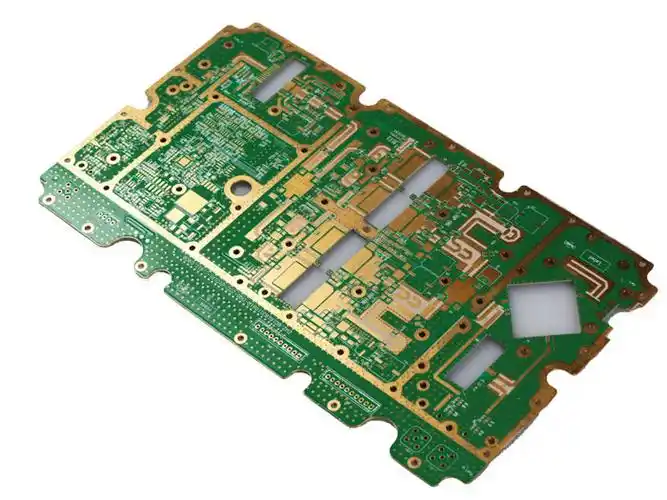
FR4 + RO4350 mixed – PCB board
An FR4 + RO4350 mixed board combines the properties of FR4 and RO4350 materials. FR4 is a common epoxy glass - fiber - reinforced laminate. RO4350, made by Rogers Corporation, is a high - performance material. This mixed board might be used to balance cost, as FR4 is relatively inexpensive, with high - frequency performance, which RO4350 offers, like better signal integrity.
Get a Quote
I. Comparison of Core Base Material Performance
The performance advantages of a 6 - layer FR4 and RO4350 mixed - material board stem from the complementary characteristics of the two base materials. The differences in their core parameters directly determine the applicable scenarios of the mixed - material board. The specific comparison is as follows:
| Performance Parameters | FR4 Base Material (Epoxy Glass Cloth) | RO4350 Base Material (High - frequency Composite Material) |
|---|---|---|
| Dielectric Constant (Dk, at 10GHz) | 4.2 - 4.7 (Fluctuates significantly with frequency) | 3.48 ± 0.05 (Extremely stable at high frequencies) |
| Dielectric Loss (Df, at 10GHz) | 0.018 - 0.025 (High loss, significant signal attenuation) | 0.0031 ± 0.0004 (Very low loss, suitable for high - frequency signal transmission) |
| Operating Frequency Range | Mainly suitable for low - to - medium - frequency scenarios below 5GHz | Supports DC - 40GHz high - frequency scenarios, meeting millimeter - wave application requirements |
| Coefficient of Thermal Expansion (CTE) | X/Y - axis: 13 - 17ppm/℃; Z - axis: 50 - 60ppm/℃ (Larger expansion in the Z - axis) | X/Y - axis: 14ppm/℃; Z - axis: 33ppm/℃ (Better Z - axis stability) |
| Mechanical Strength | Flexural strength: 150 - 200MPa, good rigidity, strong impact resistance | Flexural strength: 120 - 150MPa, moderate rigidity, better toughness |
| Cost Level | High cost - performance, low cost for mass applications | Premium for high - frequency characteristics, cost is about 3 - 5 times that of FR4 |
As can be seen from the parameters, the advantages of FR4 are concentrated in the cost and mechanical properties in low - to - medium - frequency scenarios, while RO4350 excels in high - frequency signal integrity and environmental stability. The design logic of the mixed - material board is to achieve a balance of "meeting performance requirements + cost control" through the combination of "using RO4350 for high - frequency layers and FR4 for auxiliary layers".
II. Typical Structural Design of 6 - layer Mixed - material Board
The structural design of a 6 - layer FR4 and RO4350 mixed - material board needs to focus on "optimizing the signal transmission path". The core idea is to plan the high - frequency signal layers, power/ground layers, and low - speed signal layers separately, ensuring that high - frequency signals are only transmitted in the RO4350 base material to reduce signal loss. The following is the most commonly used symmetrical 6 - layer structural design (from the top layer to the bottom layer):
- Top Layer (Layer 1): Signal layer, using RO4350 base material. It is mainly used to arrange high - frequency signal lines (such as RF antennas, high - speed data interfaces), directly connecting to external high - frequency devices (such as RF chips, filters) to ensure low - loss at the starting point of signal transmission.
- Second Layer (Layer 2): Ground layer, using RO4350 base material. Together with the top - layer signal layer, it forms a "signal - ground" microstrip line structure. The low Df characteristic of RO4350 can reduce the parasitic loss between the ground plane and the signal layer, and at the same time stabilize the impedance of high - frequency signals.
- Third Layer (Layer 3): Power layer, using FR4 base material. It is used to provide the DC power supply of the circuit board (such as 3.3V, 5V power). The high insulation and low cost of FR4 can meet the insulation requirements of the power layer and reduce the overall cost.
- Fourth Layer (Layer 4): Low - speed signal layer, using FR4 base material. Arrange low - speed control signals (such as I2C, SPI protocol signals) or auxiliary lines (such as indicator lights, button interfaces). These signals are not sensitive to transmission loss, and the performance of FR4 fully meets the requirements.
- Fifth Layer (Layer 5): Ground layer, using RO4350 base material. Corresponding to the bottom - layer signal layer, it forms a "ground - signal" symmetrical structure, further optimizing the return path of high - frequency signals and reducing crosstalk.
- Bottom Layer (Layer 6): Signal layer, using RO4350 base material. It is used to arrange another high - frequency signal (such as the receiving - end RF signal), forming a dual - high - frequency channel with the top layer, suitable for high - frequency modules that integrate transmission and reception (such as radars, wireless communication devices).
The core advantage of this structural design lies in "closed - loop high - frequency signal transmission" - the top layer, bottom layer, and corresponding ground layers all use RO4350 to form an independent high - frequency signal transmission channel; the middle power layer and low - speed signal layers use FR4, which not only prevents high - frequency signals from entering the FR4 area with higher loss but also improves the overall structural stability of the circuit board through the high rigidity of FR4. In addition, the symmetrical structure can effectively offset the internal stress during multi - layer board lamination, reducing the risk of warping.
III. Analysis of the Core Advantages of the Mixed - material Board
Compared with pure FR4 multi - layer boards or pure RO4350 multi - layer boards, the advantages of a 6 - layer FR4 and RO4350 mixed - material board are reflected in the dual balance of "performance adaptability" and "cost - effectiveness", which can be summarized into three points:
(1) Significantly Improved High - frequency Signal Integrity
In high - frequency scenarios, signal attenuation and distortion mainly result from the dielectric loss (Df) and dielectric constant (Dk) fluctuations of the base material. In the mixed - material board, high - frequency signals are only transmitted in the RO4350 base material. Its low Df (0.0031) characteristic can reduce the transmission loss of 10GHz signals by more than 60% (compared to FR4), and at the same time, the stability of Dk (±0.05) can ensure that the signal impedance deviation is controlled within 5%, avoiding signal reflection caused by impedance mismatch. For example, in the RF module of a 5G base station, the mixed - material board can increase the effective transmission distance of RF signals by 30%, reducing the burden on the signal amplification circuit.
(2) Precise Balance of Cost and Performance
The cost of a pure RO4350 6 - layer board is about 4 - 6 times that of a pure FR4 6 - layer board. However, through the combination of "2 - 3 layers of RO4350 + 3 - 4 layers of FR4", the cost of the mixed - material board can be controlled at 50% - 60% of that of a pure RO4350 board. For devices that contain both high - frequency and low - speed signals (such as industrial IoT gateways, vehicle - mounted radars), the mixed - material board does not need to pay the premium of high - frequency base materials for low - speed signals while meeting the performance requirements of high - frequency signals. Taking a certain vehicle - mounted millimeter - wave radar as an example, after using the mixed - material board, the cost of a single circuit board is reduced by about 40%, and the radar detection distance and resolution are basically the same as those of the pure RO4350 solution.
(3) Stronger Structural Stability and Environmental Adaptability
The long - term reliability of multi - layer boards depends on the thermal stability and mechanical strength of the base materials. The high rigidity of FR4 (flexural strength of 200MPa) can improve the overall impact resistance of the mixed - material board, while the lower Z - axis CTE of RO4350 (33ppm/℃) can reduce the Z - axis expansion of the circuit board during high - temperature soldering (such as reflow soldering, peak temperature of 260℃), reducing the risk of via cracking. In addition, RO4350 has better resistance to heat and humidity (after being placed in an 85℃/85% RH environment for 1000 hours, the Dk change rate < 1%), enabling the mixed - material board to adapt to harsh environments such as aerospace and industrial control (such as high - temperature, high - humidity, and vibration scenarios).
IV. Key Points of the Manufacturing Process
The manufacturing difficulty of a 6 - layer FR4 and RO4350 mixed - material board is higher than that of a multi - layer board with a single base material. The core challenge lies in the differences in the coefficient of thermal expansion and curing characteristics of the two base materials, which may lead to problems such as delamination and warping during lamination. The following process links need to be controlled with emphasis:
(1) Base Material Pretreatment: Unify Surface Characteristics
The surface roughness and resin content of FR4 and RO4350 differ greatly. Pretreatment is required to ensure their tight combination:
- FR4 Base Material: Use the "alkaline etching + micro - etching" process to remove the surface oxide layer and control the surface roughness (Ra) within 1.5 - 2.0μm to enhance the bonding force with the prepreg.
- RO4350 Base Material: Use the plasma cleaning process to remove surface oil and impurities while retaining its low - loss characteristics, avoiding damage to the base - material structure by chemical treatment.
(2) Lamination Process: Precisely Control Temperature and Pressure
The curing temperature ranges of the two base materials are different (FR4 curing temperature is 170 - 180℃, and RO4350 curing temperature is 160 - 170℃). A stepped lamination curve needs to be designed:
- Heating Stage: Increase the temperature from room temperature to 165℃ at a rate of 2℃/min and hold for 30 minutes to ensure that RO4350 is initially cured.
- Pressurizing Stage: Gradually increase the pressure to 30 - 35kg/cm² at 165℃ to avoid substrate displacement caused by sudden pressure increase.
- Second Heating Stage: Increase the temperature to 175℃ at a rate of 1℃/min and hold for 60 minutes to fully cure FR4.
- Cooling Stage: Decrease the temperature to room temperature at a rate of 3℃/min to reduce internal stress accumulation and control the warpage degree ≤ 0.5%.
(3) Drilling and Electroplating: Ensure Via Reliability
The fiber structure of RO4350 is denser, and problems such as "burrs" and "rough hole walls" are likely to occur during drilling. Special tools and parameters need to be used:
- Drilling Tool: Select an ultra - fine - grained cemented carbide drill bit (diameter 0.2 - 0.5mm), control the rotation speed at 30000 - 40000rpm, and the feed rate at 50 - 80mm/min.
- Hole - wall Treatment: Use the "electroless copper plating + electro - plating copper" process. The electroless copper plating thickness should be ≥ 0.5μm, and the electro - plating copper thickness should be ≥ 20μm to ensure the electrical conductivity and peel - off resistance (≥ 1.5N/mm) of the vias.
V. Typical Application Scenarios
The application scenarios of a 6 - layer FR4 and RO4350 mixed - material board are concentrated in electronic devices that "need to handle both high - frequency and low - speed signals and are cost - sensitive", mainly including three major fields:
(1) Communication Equipment Field
- 5G Base Station Radio - frequency Unit (RRU): It needs to transmit both 2.6GHz/3.5GHz high - frequency RF signals and low - speed control signals. The mixed - material board can reduce RF signal loss and control the cost of the base station.
- Satellite Communication Terminal: With an operating frequency of 10 - 20GHz, it needs to withstand the high - and - low - temperature cycle in space environment (-55℃ - 85℃). The low CTE characteristic of RO4350 can ensure the long - term reliability of the terminal, and FR4 reduces the overall weight and cost of the terminal.
(2) Automotive Electronics Field
- Vehicle - mounted Millimeter - wave Radar (24GHz/77GHz): The radar signals need to be transmitted with low loss, while the power management and data - acquisition modules of the radar are low - speed signals. The mixed - material board can balance the performance of the radar and the cost of the whole vehicle, and it has been widely used in L2/L3 - level autonomous driving vehicles.
- Vehicle - mounted Wireless Charging Module: The transmission frequency is 150kHz (medium - frequency), but it needs to be compatible with Bluetooth (2.4GHz) communication signals. The mixed - material board can meet both the medium - frequency energy transmission and high - frequency communication requirements.
(3) Industrial and Medical Electronics Field
- Industrial Internet of Things (IIoT) Gateway: It needs to process multi - band signals such as LoRa (915MHz) and WiFi 6 (5GHz). The mixed - material board can reduce crosstalk between different frequency - band signals and improve the communication distance and stability of the gateway.
- Medical Imaging Equipment (such as Ultrasound Diagnostic Instrument): The signal transmission frequency of the ultrasound probe is 5 - 10MHz (medium - frequency), while the control module of the equipment is a low - speed signal. The mixed - material board can ensure the high - fidelity of ultrasound signals and at the same time reduce the manufacturing cost of medical equipment.


