



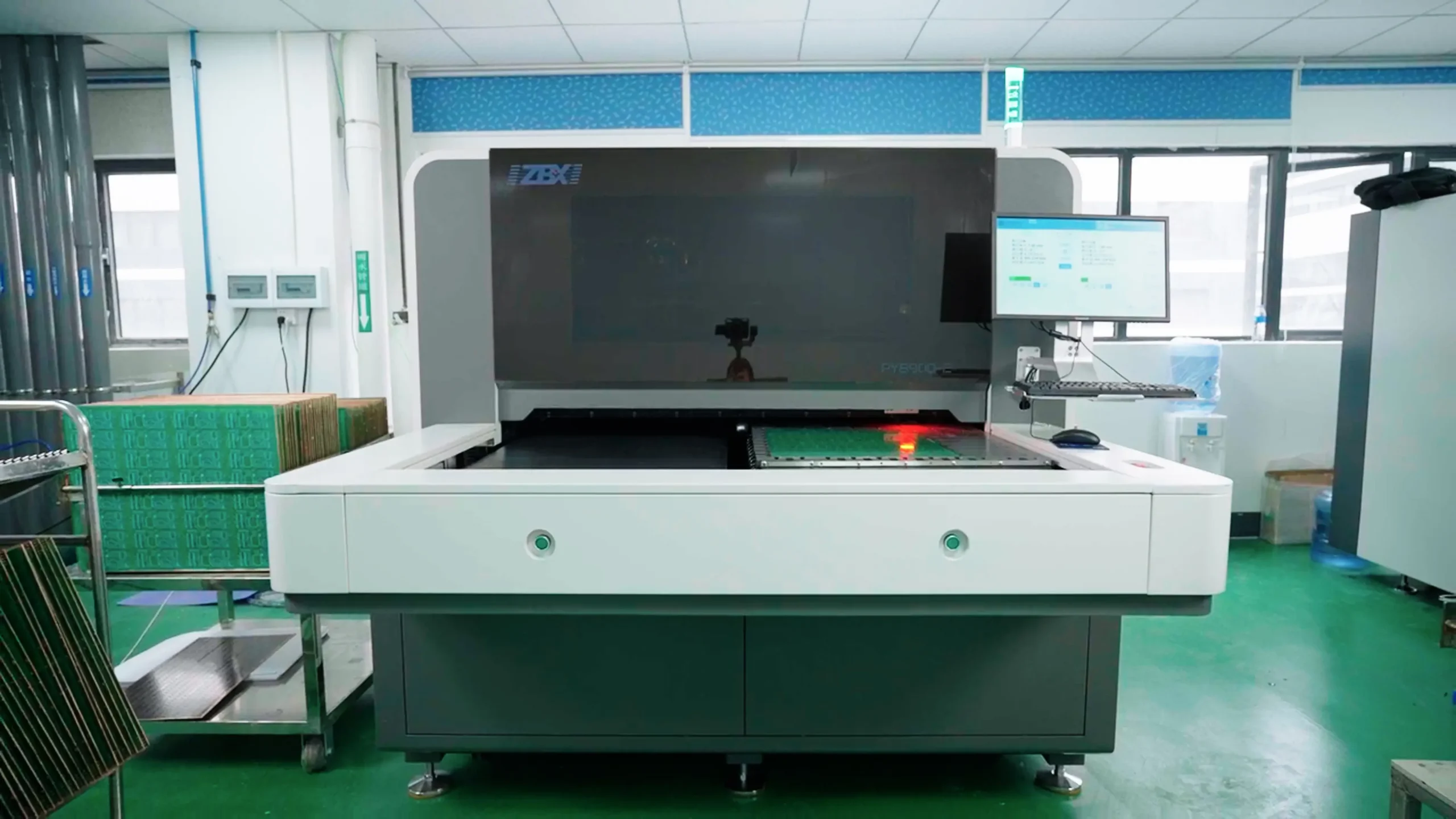
PCB automatic printing machine
PCB自动文本打印机是一种用于在印刷电路板(PCB)上自动打印文本、符号、徽标和其他信息的设备。主要有两种类型:喷墨型和丝网印刷型。
Get a Quote
PCB Automatic Text Printing Machine: The "Information Labeling Expert" in PCB Manufacturing
In the manufacturing process of printed circuit boards (PCBs), text printing is an essential post - process. Its core function is to clearly and accurately print identification information on the PCB surface, such as component reference designators, polarity symbols, manufacturer logos, version numbers, etc. This information serves as a "navigation map" for subsequent SMT (Surface Mount Technology) pasting, manual repair, and product traceability, and is also crucial for ensuring the consistency and reliability of PCB production. As the core device for implementing this process, the PCB automatic text printing machine, with its advantages of automation, high precision, and high stability, has comprehensively replaced traditional manual printing and become a standard device in modern PCB production lines, profoundly influencing the efficiency and quality of PCB manufacturing.
In terms of technical principles and structural design, PCB automatic text printing machines mainly follow two technical routes: ink - jet type and screen - printing type. The two have their own focuses in working logic, core components, and application scenarios, jointly covering the production requirements of different types and quantities of PCBs.
The ink - jet type PCB text printing machine has the core advantage of "digital direct printing". It doesn't require the production of a physical printing plate. Instead, it directly drives the print head through digital signals to spray text patterns. Its working process can be divided into three core steps: "positioning - printing - curing". In the positioning stage, the device uses high - resolution CCD cameras (usually 2 - 4) to capture the fiducial points (Mark points) on the PCB. Combining machine vision algorithms, it automatically calculates the position deviation of the PCB and drives the X/Y/Z - axis servo motors in real - time for compensation, ensuring that the printing position accuracy is controlled within ±50μm. This accuracy is sufficient to meet the needs of high - precision PCBs such as Mini LED and automotive electronics. In the printing stage, according to the Gerber/ODB++ files exported from the CAM software, the device parses the text patterns into digital instructions, controls the piezoelectric precision print head (with a nozzle diameter mostly of 20 - 50μm) to move along the preset path, and at the same time sprays UV - curable text ink onto the PCB surface in the form of tiny ink droplets (with a volume as low as 10 - 30pl). Since the piezoelectric print head doesn't need to touch the PCB, it can effectively avoid scratching the board surface, especially suitable for vulnerable substrates such as flexible PCBs (FPCs) and thin PCBs. Finally, the printed text immediately enters the built - in UV - curing channel. Through ultraviolet irradiation, the ink is quickly cured within 1 - 3 seconds, ensuring that the adhesion of the text meets the standard and avoiding wear or peeling in subsequent processes. Structurally, the ink - jet type device mainly consists of four core modules: the "high - precision transmission system", the "vision positioning system", the "piezoelectric printing system", and the "UV - curing system". The transmission system uses a combination of linear guides, ball screws, and grating rulers to achieve closed - loop control of motion accuracy. The vision system is equipped with a million - pixel - level industrial camera and special image - processing algorithms to handle minor deformations of the PCB and contamination of fiducial points. The printing system is equipped with an automatic print - head cleaning device and ink - level monitoring function to reduce the risk of print - head clogging. The UV - curing system adapts to different thicknesses and materials of text inks by adjusting the ultraviolet intensity and irradiation time.
The screen - printing type PCB text printing machine continues the "print - plate transfer" logic of traditional screen printing, with the core advantages of "high adhesion" and "high productivity", making it more suitable for the production of large - quantity, standardized PCBs. Its core principle is to align the "hollow areas" of the pre - made screen printing plate (usually a polyester or stainless - steel screen with a mesh count of 300 - 500 meshes) with the PCB surface, and then apply uniform pressure through a squeegee to transfer the text ink through the hollow areas onto the PCB, forming clear text markings. Different from the ink - jet type, the key points of screen - printing are "print - plate accuracy" and "squeegee control". The production of the printing plate requires laser engraving technology to ensure that the text edges are free from serrations and deformation, and the screen tension needs to be kept stable (usually 25 - 35N/cm), otherwise, the text pattern may be stretched or blurred. The squeegee system is driven by a servo motor, which can precisely adjust the squeegee pressure (5 - 20N), printing speed (50 - 200mm/s), and printing angle (60° - 80°), optimizing parameters for different thicknesses of PCBs (such as 0.4 - 3.2mm) and inks (such as matte ink, high - temperature - resistant ink) to avoid defects such as "missing printing", "ghosting", and "ink accumulation". In terms of structural design, in addition to the vision positioning module and servo transmission module similar to the ink - jet type, the screen - printing type device also adds a "screen - plate replacement mechanism" and an "ink recovery system". The screen - plate replacement mechanism adopts a quick - gripper design, enabling the switching of different types of screen plates in 3 - 5 minutes, meeting the flexible production requirements of multi - variety PCBs. The ink recovery system scrapes the excess ink on the screen back into the material tank through a scraper, with an ink utilization rate of over 90%, reducing production costs and environmental pressure.
The two types of PCB automatic text printing machines have distinct differences in performance characteristics and application scenarios. The core advantages of the ink - jet type device lie in "flexibility" and "high precision". Without the need to make a screen plate, it can quickly respond to small - batch and multi - variety order requirements, especially suitable for text printing on PCB samples in the R & D stage and customized PCBs. At the same time, the printed text resolution can reach 300 - 600DPI, clearly presenting small characters (such as a reference designator of 0.8mm×0.4mm), meeting the labeling requirements of high - density PCBs. However, the printing speed of the ink - jet type device is relatively slow (the printing time for a single PCB is about 10 - 30 seconds), and the cost of UV ink is relatively high, making it more suitable for small - to - medium - batch and high - precision production scenarios. Typical applications include medical PCBs and aerospace PCBs, where strict requirements are placed on label accuracy.
The screen - printing type device, on the other hand, has "high productivity" and "high cost - effectiveness" as its core competitiveness. The printing time for a single PCB can be controlled within 5 - 15 seconds. With an automatic loading and unloading mechanism, continuous production can be achieved, with a daily production capacity of 10,000 - 20,000 pieces, fully meeting the mass - production needs of consumer electronics (such as mobile phone PCBs and router PCBs). In addition, the solvent - based or thermosetting inks used in screen printing have a lower cost, and the ink layer thickness can reach 10 - 30μm, with stronger adhesion, being able to withstand the high - temperature environment of subsequent wave soldering and reflow soldering (usually can withstand temperatures above 260℃). However, its limitation is that it requires the production of a screen plate, resulting in a higher change - over cost, and the text resolution is limited by the screen mesh count (usually 200 - 300DPI), making it difficult to meet the printing requirements of ultra - small characters. It is more suitable for standardized and large - batch PCB production.
In modern PCB manufacturing, the technical development of PCB automatic text printing machines is moving towards "higher precision", "more intelligent", and "more environmentally friendly" directions. In terms of precision, some high - end devices have adopted "AI vision positioning algorithms", which can simultaneously identify multiple fiducial points and automatically compensate for PCB warping and offset, with the positioning accuracy breaking through ±20μm, suitable for ultra - precise products such as 5G base - station PCBs and vehicle - mounted radar PCBs. In terms of intelligence, the device is integrated with an MES system interface, which can upload production data in real - time (such as printing yield, ink consumption, and device operating status), achieving full traceability and remote monitoring of the production process. At the same time, it has a "fault self - diagnosis" function, which can automatically identify problems such as print - head clogging and UV lamp failure and issue early warnings, reducing device downtime. In terms of environmental protection, the ink - jet type device uses solvent - free UV ink, with VOCs emissions much lower than traditional solvent - based inks. The screen - printing type device reduces waste through a closed - loop ink recovery system, in line with the global green manufacturing trend in the PCB industry.
From typical application cases, different types of PCB automatic text printing machines have been deeply integrated into various sub - fields. In the consumer electronics field, the screen - printing type device, with its high productivity, prints component reference designators in batches on mobile phone PCBs, ensuring the efficient progress of SMT pasting. In the automotive electronics field, the ink - jet type device prints high - temperature - resistant markings on engine control unit (ECU) PCBs, ensuring that the text does not peel off in harsh environments from - 40℃ to 150℃. In the medical electronics field, high - precision ink - jet devices print tiny polarity symbols on implantable PCBs (such as pacemaker PCBs), avoiding medical accidents caused by blurred markings.
.


